
Steam Shower
Installation.
Lower Mainland.
Residential steam shower plumbing across Langley, Vancouver and the North Shore — generator sizing and siting, steam head placement, drainage, and the serviceable access that most steam installations are missing a year after handover.
What customers say
4.9 average customer rating
★★★★★
Excellent work! Highly recommend. Professional and efficient; would use again.
Noelle, ChilliwackFaucet installationAugust 2026
★★★★★
Benneth is very knowledgeable, professional, and reliable. He made a great first impression, and I will be using him again for other jobs. Highly recommend!
Joel M., BurnabyToilet installationJuly 2026
★★★★★
Excellent service from Ben at Seastack Mechanical. Ben demonstrated exceptional professionalism, honesty, and work ethic throughout the entire job. His response time was very quick, and he was a pleasure to work with. Although I had mistakenly omitted some of my requirements in the original work order, Ben did not hesitate to return to my home a second time to ensure everything was completed exactly as I wanted. What impressed me most was that he never asked for any additional payment, even though the extra visit was clearly beyond the original scope of work. His positive attitude, integrity, and commitment to customer satisfaction truly stood out. He made sure every aspect of the job was completed to a high professional standard. I am extremely satisfied with his service and would not hesitate to call him again for any future plumbing needs. Highly recommended!
Stephen, MissionHeating system repair (new gas top connection)May 2026
Further reading: our luxury bathroom rough-in checklist and whether your house can run a custom shower.
A Steam Shower Is A Building Decision, Not A Fixture Choice
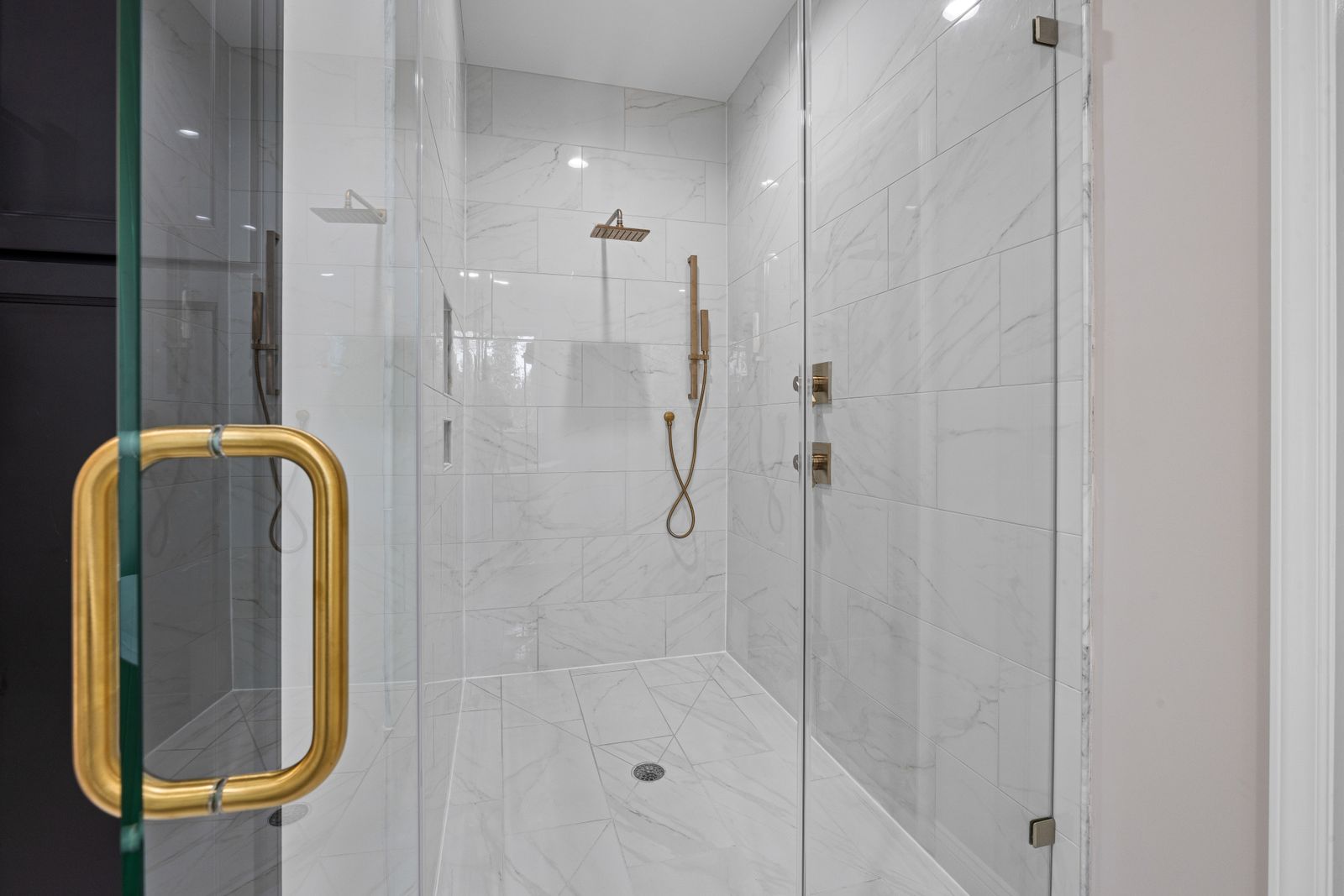
Unlike almost everything else in a bathroom, a steam shower changes what the enclosure itself has to be. The ceiling has to slope so condensate runs off instead of dripping on somebody. The enclosure has to seal to the ceiling. The tile assembly has to be a vapour-tight system, not a conventional shower with a steam head added. And the generator has to live somewhere it can be reached, drained and eventually replaced.
That is why this gets decided with the designer, the tiler and the electrician in the room, early — not specified at the end as an upgrade.
- Generator sized to the enclosure volume, the tile material and the ceiling height
- Generator sited within the manufacturer’s permitted pipe run of the steam head
- Accessible location with a drain, a shut-off and room to service it
- Steam head placed low, away from the seat and away from where anyone stands
- Sloped ceiling and full-height enclosure co-ordinated before framing
- Dedicated electrical supply arranged with the electrician at rough-in
How We Approach It
Volume & Materials
We measure the enclosure and account for what it is lined with. Stone, large-format porcelain and glass all pull heat differently, and an undersized generator never quite gets there.
Generator Location
A vanity base, a linen closet, a nearby mechanical space or an attic — whichever sits inside the permitted run and can be reached without demolition.
Supply, Drain & Power
Cold feed, a drain for the auto-flush cycle, and the dedicated circuit co-ordinated with the electrician. The auto-drain is what keeps the unit alive in hard-water areas.
Rough-In With The Tiler
Steam head, control, and any aroma or light accessory set out before the waterproofing goes on, so nothing is cut into a finished membrane.
Shower Valve Alongside
Most steam enclosures are also a working shower. The thermostatic valve and outlets are planned at the same time.
Commissioning
Fill, flush, run up to temperature, confirm the cut-out and the auto-drain, and walk you through the controls and the descaling interval.
The Mistakes We Get Called To Fix
- Generator buried behind finished tile or drywall with no access panel
- Generator sized for the floor area instead of the enclosure volume
- No drain at the generator, so the auto-flush was never commissioned
- Steam head at shoulder height, where it scalds
- Flat ceiling, so condensate drips straight down on the user
- Enclosure stopped short of the ceiling and the steam leaves the room
Every one of those is cheap to avoid and expensive to correct.
Questions We Are Asked
What does a steam shower need that a regular shower does not?
A steam generator with its own location, drain and dedicated electrical circuit, a fully enclosed shower with a door that seals, a ceiling sloped so condensation runs to the wall rather than dripping, waterproofing on every surface including the ceiling, and a steam head placed away from where people sit.
Where does the steam generator go?
Within a short run of the shower, in a vanity, closet or adjacent space with access for service. It needs a drain, water supply and power, and it must be reachable later without opening tile.
Can a steam shower be added to an existing bathroom?
Sometimes, if the shower can be fully enclosed and there is space and power for the generator. It is far easier and cheaper to plan it into a renovation than to retrofit it afterward.
Who installs what on a steam shower?
We rough in and connect the plumbing side: supply, drain, steam line and head. An electrician wires the generator and control. The tile setter waterproofs and slopes the ceiling. We coordinate the three so nothing is closed before it is tested.
Thinking About Steam?
Send the bathroom drawings and the enclosure dimensions. We will size the generator and tell you where it has to live before the framing is closed.